


Blog記事一覧 > 施術,疲労,痛み,筋肉,肩こり,腰痛,血流 > Why You Can Still Get Shoulder Stiffness Even When Using a Backpack | Explained by Nishishinjuku 7-Chome Japanese Physical Therapy & Bone-Setting
Why You Can Still Get Shoulder Stiffness Even When Using a Backpack | Explained by Nishishinjuku 7-Chome Japanese Physical Therapy & Bone-Setting
【 Key Points of This Article】
Even when you use a backpack instead of a shoulder bag, neck and shoulder stiffness can still happen. A backpack may distribute weight more evenly than a one-sided bag, but if the straps are loose, the bag hangs too low, the head moves forward, or the shoulders stay slightly lifted, the neck, shoulder blades, upper back, ribs, and lower back can still become overloaded. Many travelers in Shinjuku and office workers around Nishishinjuku 7-chome carry laptops, luggage, cameras, and heavy backpacks for long periods. At Nishishinjuku 7-Chome Japanese Physical Therapy & Bone-Setting, we check not only the painful shoulder area, but also posture, shoulder blade movement, upper back mobility, rib cage movement, breathing, pelvis position, and walking balance through anatomy-based clinical reasoning.
A Backpack Should Be Better, So Why Do My Shoulders Still Hurt?
Many people think, “A backpack uses both shoulders, so it should not cause shoulder stiffness.”
That is partly true.
Compared with carrying a bag on only one shoulder, a backpack can distribute weight more evenly.
However, shoulder stiffness can still appear when the backpack is heavy, worn too low, or used for a long time. This is common among travelers visiting Shinjuku, business people carrying laptops, and office workers who commute every day with a packed backpack.
At Nishishinjuku 7-Chome Japanese Physical Therapy & Bone-Setting, we often hear:
“My shoulders feel heavy after walking around Tokyo.”
“My neck gets stiff even though I use a backpack.”
“My upper back feels tight after commuting.”
“My shoulders get worse after work, especially after using a laptop all day.”
This is not just about the bag. It is about how your body supports the bag.
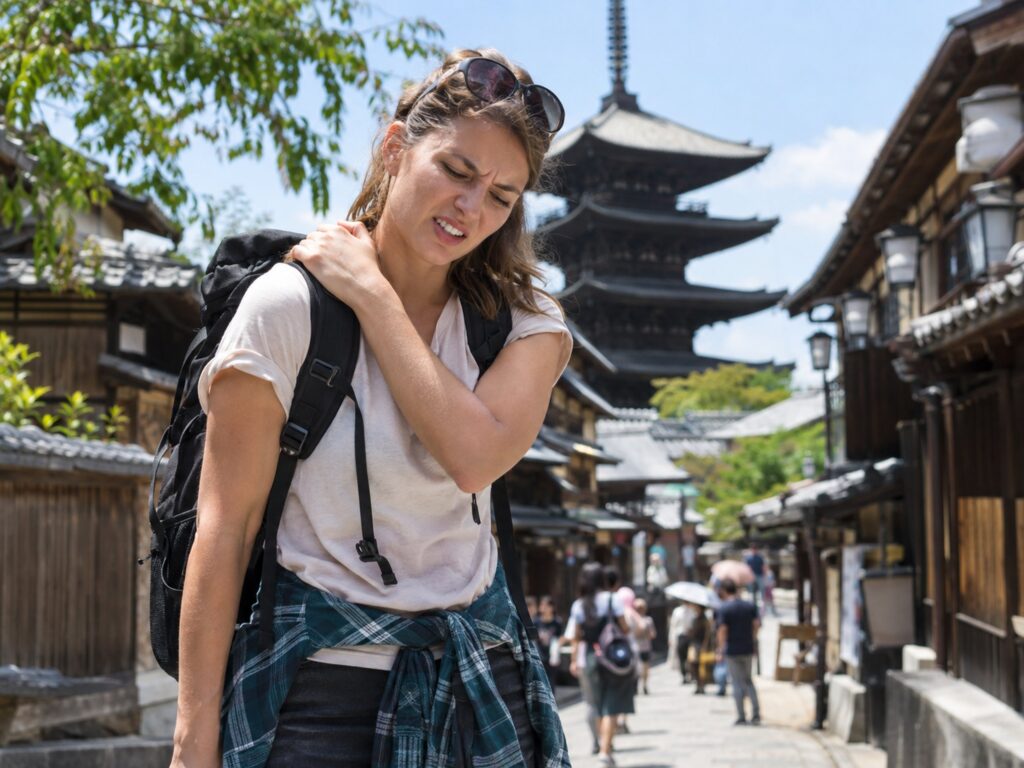
A Heavy Backpack Pulls Your Body Backward
When a backpack is on your back, its weight pulls your upper body backward.
To prevent yourself from falling backward, your body often reacts by moving the head and chest slightly forward. This creates a posture where the head sits in front of the body instead of directly above the spine.
Looking at how the body moves as a whole, this increases the work required from the muscles in the back of the neck and shoulders.
The main muscles that become overloaded include:
the small muscles at the base of the skull that support the back of the head, known as the suboccipital muscles,
the muscle running from the neck to the shoulder, known as the upper trapezius,
the muscle that lifts the shoulder blade toward the neck, known as the levator scapulae,
and the muscles between the shoulder blades that stabilize the upper back, known as the rhomboids.
In plain terms, think of it as:
the muscle that supports the back of the head (suboccipital muscles)
the muscle that tenses across the neck and shoulder (upper trapezius)
the muscle that lifts the shoulder blade (levator scapulae)
the muscle that holds the shoulder blades in place (rhomboids)
In simple terms, your neck and shoulders are trying to stop your head and backpack from pulling your posture out of balance.
The Neck Muscles Work Harder Than You Realize
When your head moves forward while wearing a backpack, the suboccipital muscles under the back of the skull must work harder to hold the head up.
The upper trapezius and levator scapulae also stay active for a long time. These muscles are often felt as stiffness at the base of the neck, tightness around the shoulders, or heaviness behind the head.
This is why some people feel:
neck stiffness,
shoulder tightness,
heaviness around the back of the head,
tension headaches,
or tiredness after walking with a backpack.
Even if the backpack is balanced on both shoulders, the neck can still become overloaded if the head moves forward.
The Shoulder Blades Can Become Fixed
A backpack also affects the shoulder blades.
The straps press down on the shoulders and can limit how freely the shoulder blades move. If the backpack is heavy, the rhomboids and surrounding muscles around the shoulder blades must work to stabilize the load.
The shoulder blades should normally glide over the rib cage when you walk, move your arms, or breathe.
But when the straps hold the shoulders down and the upper back becomes tense, the shoulder blades may move less.
This can lead to stiffness between the shoulder blades, tightness around the upper back, and a feeling that the shoulders are always heavy.
In many cases, rubbing only the shoulder area gives temporary relief, but the stiffness comes back because the shoulder blades and rib cage are not moving well.
Breathing Can Become Shallow
When a backpack is heavy, the chest and upper back may become tense. The rib cage may not expand as smoothly.
Breathing is not only a lung movement. The ribs, the diaphragm (the muscle beneath the lungs that helps you breathe), the spine, and the muscles around the chest all need to move together.
If the rib cage becomes stiff, breathing can become shallow.
When breathing becomes shallow, the neck and shoulder muscles may help with breathing more than they should.
This means the neck and shoulders are doing two jobs at the same time:
supporting posture,
and helping breathing.
This is one reason why backpack-related shoulder stiffness may feel worse after a long day of walking, sightseeing, commuting, or desk work.
The Pelvis and Lower Back Are Also Involved
Backpack-related shoulder stiffness is not only a neck and shoulder problem.
When the backpack pulls the upper body backward and the head moves forward, the spine and pelvis adjust to keep balance. Some people arch the lower back. Others round the back and let the pelvis tilt backward.
Both patterns can increase stress on the lower back, hips, and pelvis.
This is why people who use backpacks for long periods may also feel:
lower back heaviness,
hip tightness,
one-sided back stiffness,
or fatigue while walking.
The body works as one connected system. The shoulders may be where you feel the pain, but the cause may involve the neck, shoulder blades, rib cage, pelvis, and walking posture.
Backpack Habits That Often Cause Neck and Shoulder Stiffness
Shoulder stiffness is more likely when:
the backpack is too heavy,
the straps are too loose,
the bag hangs low on the back,
the head moves forward,
the shoulders stay slightly lifted,
the chest becomes rounded,
or you walk for a long time without changing posture.
Travelers often carry cameras, water bottles, guidebooks, souvenirs, and laptops. Office workers often carry computers, chargers, documents, and personal items. Even if each item is small, the total load can become enough to affect posture.
What You Can Do Yourself
First, adjust the backpack so it sits close to your back.
If the bag hangs too low, it pulls your upper body backward and makes your neck work harder.
Second, tighten both straps evenly.
The backpack should not swing side to side when you walk.
Third, reduce unnecessary weight.
A lighter bag means less work for the neck, shoulders, spine, and pelvis.
Fourth, take short movement breaks.
Gently roll your shoulders, move your shoulder blades, look straight ahead, and breathe out slowly.
The goal is not to force “perfect posture.”
The goal is to let your neck, shoulders, rib cage, and back move again.
How We Check This at Nishishinjuku 7-Chome Japanese Physical Therapy & Bone-Setting
At Nishishinjuku 7-Chome Japanese Physical Therapy & Bone-Setting, we do not look at backpack-related shoulder stiffness as a shoulder-only problem.
We check head position, neck mobility, shoulder blade movement, upper back stiffness, rib cage movement, breathing pattern, pelvis position, lower back tension, and walking balance.
Our approach is based on anatomy-based clinical reasoning.
We ask:
Why does the neck become overloaded?
Are the shoulder blades moving properly?
Is the rib cage limiting breathing?
Is the pelvis compensating for the backpack weight?
Is desk posture making the stiffness worse after commuting?
By checking the whole body, we can better understand why the stiffness keeps returning.
Easy to Consult for These Symptoms
You may benefit from a consultation if you experience:
neck stiffness after using a backpack,
shoulder heaviness after commuting,
upper back tightness after sightseeing,
stiffness between the shoulder blades,
head heaviness after laptop work,
or shoulder stiffness that gets worse after work.
Nishishinjuku 7-Chome Japanese Physical Therapy & Bone-Setting is an osteopathic clinic for desk workers in Nishishinjuku 7-chome, and we also support travelers who feel neck, shoulder, or lower back discomfort from walking, commuting, luggage, or long hours at a computer.
We are open on weekdays with reception until 8:30 PM, closing at 9:00 PM, making it easier to visit after work.
On Saturdays and public holidays, reception is open until 3:30 PM, closing at 4:00 PM.
We are closed on Sundays.
When You Should See a Medical Doctor First
If you have strong numbness in the arm or hand, weakness, severe headache, dizziness, nausea, chest pain, difficulty breathing, fever, pain after an accident, or pain that worsens even at rest, please consult a medical institution first.
On the other hand, if your symptoms are chronic neck stiffness, shoulder heaviness from a backpack, posture-related discomfort, or stiffness that worsens after commuting or desk work, this is something you can consult us about.
Final Message
A backpack may look balanced, but your body may still be working hard.
The backpack pulls backward.
The head moves forward.
The suboccipital muscles and upper trapezius hold the head up.
The shoulder blades become restricted.
The rib cage moves less.
Breathing becomes shallow.
The pelvis and lower back compensate.
This chain reaction can lead to neck and shoulder stiffness.
At Nishishinjuku 7-Chome Japanese Physical Therapy & Bone-Setting, we check backpack-related neck and shoulder stiffness through anatomy-based clinical reasoning, looking at the neck, shoulder blades, rib cage, breathing, pelvis, walking pattern, and daily posture.
If you feel, “My shoulders still get stiff even with a backpack,” please do not ignore it.
Your body may be telling you that the way you carry your load needs to be checked.
Nishishinjuku 7-Chome Japanese Physical Therapy & Bone-Setting
Nishishinjuku 7-chome, Shinjuku, Tokyo
Within walking distance from Shinjuku Station, Nishi-Shinjuku Station, and Shinjuku-Nishiguchi Station
Phone: 03-6908-7120
Online booking available 24 hours